
From the source
China
31 coffees · 23 roasters · 3 processing methods
Photo by Howei Wang on Unsplash
Chinese specialty coffee is young. The country grows most of its coffee in Yunnan province in the south, where producers sit geographically close to the Laos and Myanmar borders and share climate with the Southeast Asian growing regions. Volumes were historically aimed at the commodity market; specialty is a newer investment.
The cups from top Yunnan producers now compete with mid-tier Central American lots — sweet, clean, with notes of stone fruit, cocoa, and a balanced acidity. Catimor dominates, with increasing Typica, Bourbon, and experimental varieties. Washed is standard, though natural and honey processing appear on more menus each year.
Chinese specialty is still underpriced and underrepresented in Europe. That will change. Worth getting familiar with now.
Chinese specialty coffee is jong. Het land verbouwt het meeste van zijn koffie in de provincie Yunnan in het zuiden, waar producenten geografisch dicht bij de Laotiaanse en Myanmarese grens zitten en hetzelfde klimaat delen met de Zuidoost-Aziatische teeltgebieden. Volumes waren historisch gericht op de commodity-markt; specialty is een nieuwere investering.
De koppen van top-Yunnan-producenten concurreren inmiddels met midden-Midden-Amerikaanse lots — zoet, schoon, met tonen van steenfruit, cacao en een gebalanceerde zuren. Catimor domineert, met groeiende Typica, Bourbon en experimentele variëteiten. Gewassen is standaard, hoewel natural en honey-verwerking elk jaar op meer menu’s verschijnen.
Chinese specialty is nog steeds te goedkoop en ondervertegenwoordigd in Europa. Dat zal veranderen. De moeite waard om er nu vertrouwd mee te raken.
Chinesischer Specialty Coffee ist jung. Das Land baut den größten Teil seines Kaffees in der südlichen Provinz Yunnan an, wo Produzenten geografisch nah an den Grenzen zu Laos und Myanmar sitzen und das Klima mit den südostasiatischen Anbaugebieten teilen. Die Mengen zielten historisch auf den Commodity-Markt; Specialty ist eine neuere Investition.
Die Tassen der besten Yunnan-Produzenten konkurrieren mittlerweile mit mittelamerikanischen Mid-Tier-Lots — süß, klar, mit Noten von Steinobst, Kakao und einer ausgewogenen Säure. Catimor dominiert, mit zunehmend Typica, Bourbon und experimentellen Sorten. Gewaschen ist Standard, auch wenn Natural- und Honey-Aufbereitungen jedes Jahr auf mehr Karten auftauchen.
Chinesischer Specialty ist in Europa nach wie vor zu günstig und unterrepräsentiert. Das wird sich ändern. Es lohnt sich, jetzt damit vertraut zu werden.
At a glance
- Coffees
- 31
- Roasters
- 23
- Processes
- 3
What to try first
Coffees from China worth the bag
Sorted by what Tamp drinkers reach for most. Click through for tasting notes and who's roasting them.
![[Rested] Catimor - Anaerobic Honey - Gaosanlin Coffee Farm](https://cdn.shopify.com/s/files/1/0693/6887/3282/files/ValenciaOrange_DriedApricot_BlackTea.jpg?v=1786827843)
[Rested] Catimor - Anaerobic Honey - Gaosanlin Coffee Farm
18.4 USD- orange
- apricot
Catimor - Anaerobic Honey - Gaosanlin Coffee Farm
18 USD- orange
- apricot

Catimor - Washed - "Biyesheng" Yi Nian Yi Su Collective
17.5 USD- grape
- earl grey
- red fruit

Yunnan Osmanthus
18.9 SGD- peach

100g Sunset
9 AUD- chocolate
- caramel
- dark chocolate
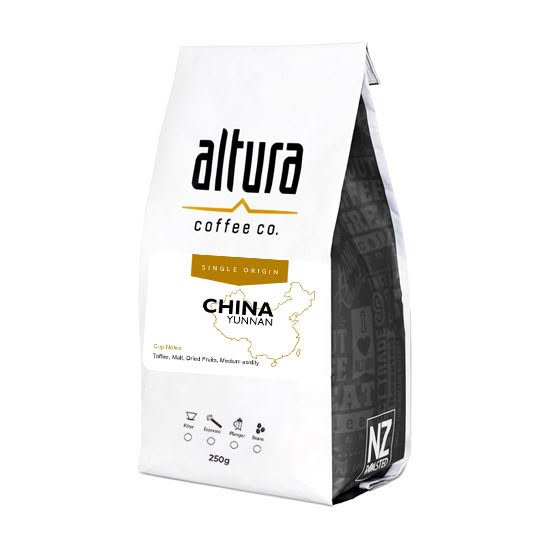
Altura Coffee China Yunnan Single Origin
15.5 NZD- toffee
- malt

Art Of Yunnan
49 USD
Aulai Co-Fermented Anaerobic Natural - Yunnan, China
18 EUR- cocoa
- tropical fruit

Bad Luk • Yunnan, China • Natural Anaerobice Fermentation
12.75 GBP- cherry
- chocolate

China
14.4 EUR- chocolate
Who to follow
Roasters known for China
- Hydrangea Coffee Roasters 3 coffees
- Three Fools Coffee 3 coffees
- Early Bird - Artisanal Coffee Roasters 2 coffees
- Imperial Jade Coffee 2 coffees
- Nero Scuro 2 coffees
By processing method
How the cherry was dried
Processing changes everything — the acidity, the body, the finish. Split the catalogue by how each coffee got to the bag.
- China anaerobic 7 coffees
- China natural 6 coffees
- China washed 9 coffees