
Myanmar’s specialty coffee is a recent story. The country has grown coffee for generations, but serious specialty investment only started in the 2010s, with producers in the Shan highlands around Ywangan and Pyin Oo Lwin learning the cupping and processing standards international buyers expect.
Altitudes push past 1,500 metres, the varieties are mostly Catuaí, SL34, and Catimor, and the processing mixes washed with a growing presence of naturals and honeys. The cup profile tends bright and fruity — stone fruit, citrus, sometimes a distinct floral lift. It’s a young origin that’s been developing quickly.
Supply is limited and political circumstances make it unpredictable. If you see a Myanmar coffee on a menu, the chances are it’s there because the roaster went to some trouble to get it.
Specialty coffee uit Myanmar is een recent verhaal. Het land verbouwt al generaties koffie, maar serieuze specialty-investeringen begonnen pas in de jaren 2010, met producenten in het Shan-hoogland rond Ywangan en Pyin Oo Lwin die de cupping- en verwerkingsstandaarden leerden die internationale inkopers verwachten.
Hoogtes stijgen boven de 1.500 meter, de variëteiten zijn voornamelijk Catuaí, SL34 en Catimor, en de verwerking mengt gewassen met een groeiende aanwezigheid van naturals en honeys. Het kopprofiel neigt helder en fruitig — steenfruit, citrus, soms een uitgesproken bloemige lift. Een jonge herkomst die zich snel ontwikkelt.
De aanvoer is beperkt en politieke omstandigheden maken hem onvoorspelbaar. Als je een Myanmar-koffie op het menu ziet, is het er waarschijnlijk omdat de brander zich enige moeite heeft getroost om hem te krijgen.
Specialty Coffee aus Myanmar ist eine junge Geschichte. Das Land baut seit Generationen Kaffee an, aber ernsthafte Specialty-Investitionen begannen erst in den 2010ern, mit Produzenten im Shan-Hochland rund um Ywangan und Pyin Oo Lwin, die die Cupping- und Aufbereitungsstandards lernten, die internationale Einkäufer erwarten.
Höhen reichen über 1.500 Meter, die Sorten sind überwiegend Catuaí, SL34 und Catimor, die Aufbereitung mischt gewaschen mit einer wachsenden Präsenz von Naturals und Honeys. Das Tassenprofil neigt zu hell und fruchtig — Steinobst, Zitrus, manchmal ein ausgeprägter blumiger Auftrieb. Eine junge Herkunft, die sich schnell entwickelt.
Die Verfügbarkeit ist begrenzt, politische Umstände machen sie unvorhersehbar. Wenn du einen Myanmar-Kaffee auf einer Karte siehst, ist er wahrscheinlich dort, weil sich die Rösterei einige Mühe gemacht hat, ihn zu bekommen.
At a glance
- Coffees
- 21
- Roasters
- 17
- Processes
- 2
What to try first
Coffees from Myanmar worth the bag
Sorted by what Tamp drinkers reach for most. Click through for tasting notes and who's roasting them.

Hopong - Myanmar
33.5 EUR- melon
- nougat
- stone fruit

Myanmar Ying Yang (Espresso roast)
17.5 SGD- vanilla
- dark chocolate
- caramel
- brown sugar

Myanmar Ying Yang (Filter roast)
17.5 SGD- raisin
- brown sugar

【NEW】Myanmar Ywangan Lat Pat Pin
3700 JPY- rose
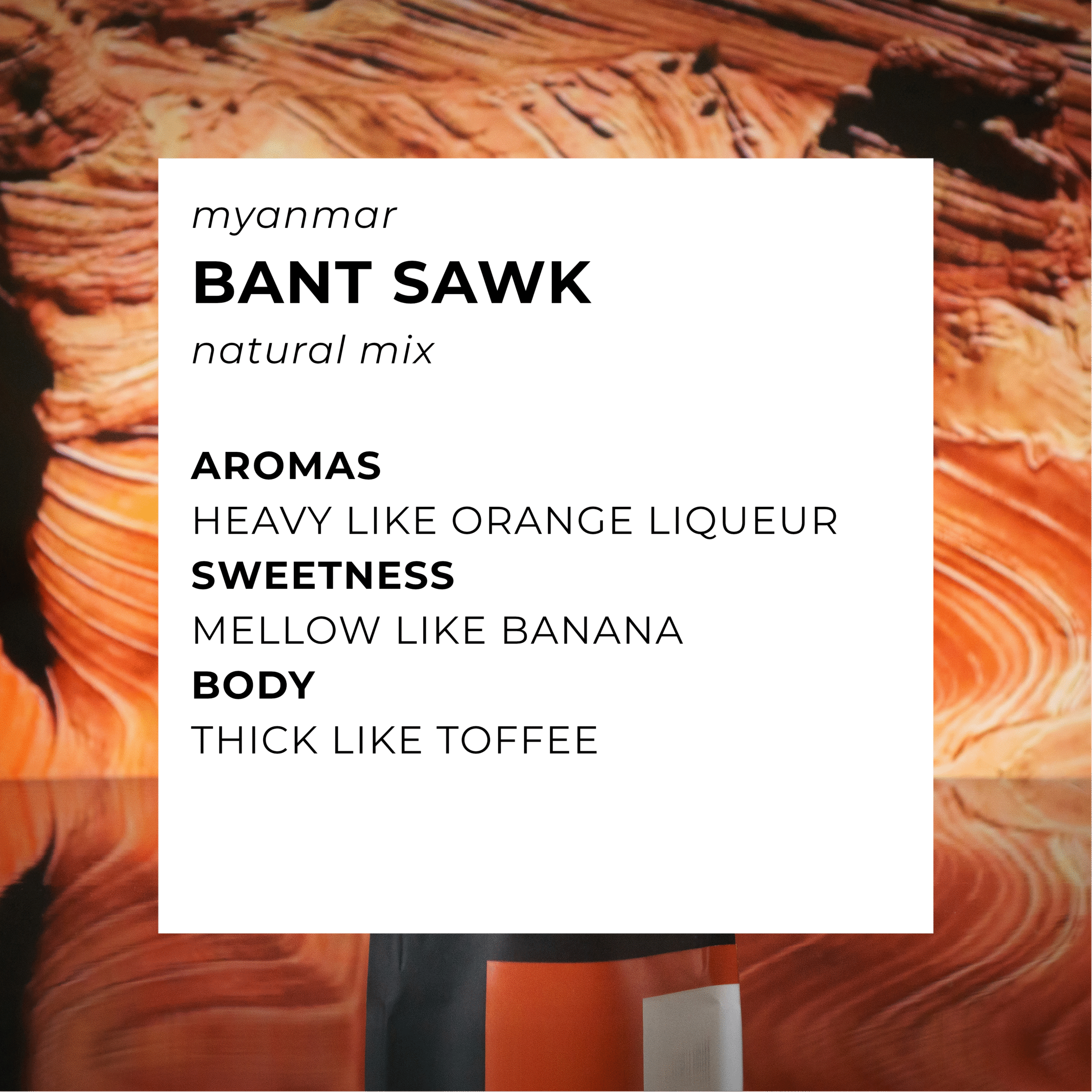
Bant Sawk
14 EUR- orange
- strawberry
- banana
- toffee

C-12 (Myanmar MGK ) Medium Roast 180g.
270 THB- lime
- plum
- macadamia

C-12 (Myanmar MGK ) Medium Roast 20g.
40 THB- lime
- plum
- macadamia

Cindy Li, Thanaka Coffee (Anaerobic Slow Dry Natural)
8 SGD- rum
- raspberry
- honey

ENDLESS SUMMER - MYANMAR
10.9 EUR- caramel
- cashew

Impact Filter | Well Grounded
13 GBP- milk chocolate
Who to follow
Roasters known for Myanmar
- BEANS Coffee Roaster 2 coffees
- Notes Coffee 2 coffees
- Parchmen & Co 2 coffees
- Zero Coffee 2 coffees
- Artefact Coffee 1 coffee
By processing method
How the cherry was dried
Processing changes everything — the acidity, the body, the finish. Split the catalogue by how each coffee got to the bag.
- Myanmar anaerobic 3 coffees
- Myanmar natural 10 coffees